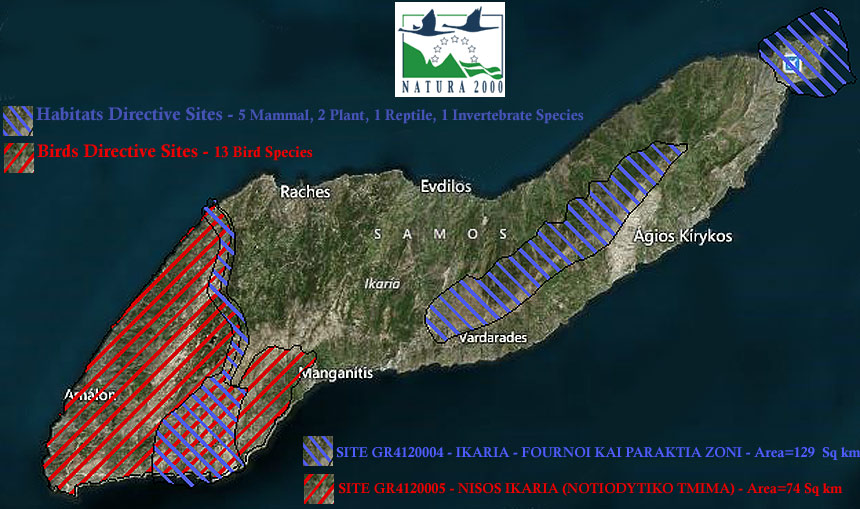
CNN has named Ikaria "The Best Greek Island for Nature Lovers", and for good reason. Ikaria exhibits a unique biodiversity rare to most Greek Islands. On Island Ikaria are located some of the most significant natural habitats in the entire Aegean Sea. Mount Atheras, the region of Faros, Chalari canyon, the area of Plagia and all the southwestern part of the island have been declared as "Zones of Special Protection" and are a part of the European Union conservation project Natura 2000.
Ikaria's landscapes are pristine, stunningly beautiful, exotic & wild, and full of contrasts. The island has an extensive mountainous topography with the Pramnos-Atheras mountain range being the highest on the island. ( Alt. 1048m (3455 ft.)
There are green slopes juxtaposing with rugged rocks, high mountain streams, small lakes & waterfalls, fresh water lagoons, hot mineral springs, pine & ancient oak forests, canyons, gorges, caves, boulder deserts, high altitude plateaus and lush valleys. In general the island supports a rare combination of terrains and ecosystems, both on land and in the sea.
Ikaria is a nature lover's paradise waiting to be discovered...
The famous Ranti Ancient Forest lies at the western edge of the Atheras mountain chain in central Ikaria and covers an area of approximately 1,600 hectares (16km2), with an elevation range of 200-800m. The forest has an average age which spans over 200 years, with some of the oldest trees more than 300 years old. The history of Ranti Forest is mysterious with dry stone walls and shelters dotting the landscape, proof of an ancient presence. Ikaria has always been a green and generously forested island. In ancient times the island was completely covered with forests and famous for its timber exports.
Ikaria's streams, rivers, small lakes and reservoirs support diverse freshwater ecosystems which are also seldom found in the Aegean islands. Many protected animal and plant species can be observed in these wetland habitats, which also constitute important stop over resting places for migratory birds on their way to and from Africa/Asia.
In sharp contrast to Ikaria's fertilty stands its strikingly mountainous and wild rocky terrain. Within the windswept high mountain ranges that are spread throughout the island there are many curious and unique landscapes to be discovered. Ikaria's vast highlands are filled with boulder deserts, plateaus, rocky hills, streams and spectacular cliffs. Although accessable, most of these areas are seldom visited owing to their remoteness, but for those who are willing to venture a breathtaking reward will accompany every step into the Ikarian mountain experience. For info on how to organize a trip see Ikarian Hiking/Walking.
The island's 255 km of coastline display an incredible range of scenery and unique seascapes. Unlike many of the neighboring islands, Ikaria's shores have remained in their natural state. Development has not been allowed to disturb the earthly beauty that has existed for thousands of years. Along the perimeter of the island there are small secluded coastal villages, quiet beaches, hidden coves, caves, therapeutic hot mineral springs flowing into the sea and mystifying rock formations to be explored and enjoyed.
The marine area north of Ikaria constitutes an important point in the migratory route of large marine mammals (and also of fish) in the Aegean as it is characterised by deep marine gorges and canyons that reach a maximum depth of 1200m. In contrast, the marine area south of Ikaria which is characterized by small slopes and depths that vary between 80 and 200m, supports permanent populations of several species of dolphins as well as of monk seals. The island's coastal zone supports ecosystems of high biodiversity as well as large areas of sea-grass beds.
Fauna and Flora
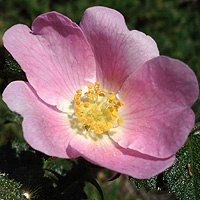
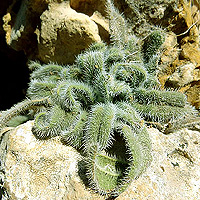 Mount Atheras and the southwestern part of Ikaria show an interesting variety in fauna and are the home of many species of rare plants, such as pinus brutia. Many of the species of fauna and flora common in the islands of the area are located on Ikaria. Concerning flora, especially in the island's south, where great lime rocks can be found, some of the more endemic species and subspecies can be
seen, such as: the Paeonia mascula cariensis and the unique species Iberis runemarkii, that grows in a few places in Plagia. Other important flora sites can be found at Faros or along river Chalaris, which flows year round towards.
Mount Atheras and the southwestern part of Ikaria show an interesting variety in fauna and are the home of many species of rare plants, such as pinus brutia. Many of the species of fauna and flora common in the islands of the area are located on Ikaria. Concerning flora, especially in the island's south, where great lime rocks can be found, some of the more endemic species and subspecies can be
seen, such as: the Paeonia mascula cariensis and the unique species Iberis runemarkii, that grows in a few places in Plagia. Other important flora sites can be found at Faros or along river Chalaris, which flows year round towards.
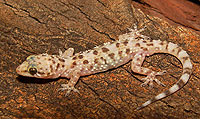 Reptile fauna on Ikaria is of Asia Minor origin in general. Along with the samiamidi Mediterranean Gecko lizard (Hemidactylus turcicus) the ophisops snakeeyed lizard (Lacertidae Lacertinae) snake and the Starred Agama (Laudakia stellio) etc. can be seen, whereas the so-called lizard of
Ikaria (Lacerta oerizeni) is found only here. The most common snakes are the ephios (Coluber juguralis) and the sapites (Malpolon
monsessulanus); none of the island's snakes are poisonous.
Reptile fauna on Ikaria is of Asia Minor origin in general. Along with the samiamidi Mediterranean Gecko lizard (Hemidactylus turcicus) the ophisops snakeeyed lizard (Lacertidae Lacertinae) snake and the Starred Agama (Laudakia stellio) etc. can be seen, whereas the so-called lizard of
Ikaria (Lacerta oerizeni) is found only here. The most common snakes are the ephios (Coluber juguralis) and the sapites (Malpolon
monsessulanus); none of the island's snakes are poisonous.
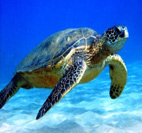 Along Ikaria's coastline many bird species nest, amongst which some are rare/endangered such as: the wild seagull, the sea raven, and the birds of prey Bonellifs Eagle (Hieraatus fasciatus), Peregrine falcon (Falco peregrinus),
and the Golden Falcon (Falco biarmicus). There are also three protected species of bat: the Rhinolofus mehelyi, the Myotis blythi and
Myotis myotis. Endangered species such as the Mediterranean seal, sea turtle, the bottlenose dolphin (Tursiops truncates) and the striped
dolphin (Stenella coeruleoalba) also find shelter along Ikaria's long coastline.
Along Ikaria's coastline many bird species nest, amongst which some are rare/endangered such as: the wild seagull, the sea raven, and the birds of prey Bonellifs Eagle (Hieraatus fasciatus), Peregrine falcon (Falco peregrinus),
and the Golden Falcon (Falco biarmicus). There are also three protected species of bat: the Rhinolofus mehelyi, the Myotis blythi and
Myotis myotis. Endangered species such as the Mediterranean seal, sea turtle, the bottlenose dolphin (Tursiops truncates) and the striped
dolphin (Stenella coeruleoalba) also find shelter along Ikaria's long coastline.
Amongst
the Greek Aegean Islands, Ikaria presents an unparalleled abundance and diversity
of unspoiled natural beauty. Civilization and development on Ikaria continue
to coexist with the island's environmental wealth and agricultural tradition.
For thousands of years visitors have come to Ikaria to rejuvenate themselves
and relax amidst the high mountains, clean air and water, organic local products, brilliant sunshine
and majestic surroundings. Ikaria has been named one of the world's five BlueZones, and the notoriously longlived and healthy Ikarians are proof of the island's healthy and therapeutic qualities derived from its natural environment.
Ikaria Natura 2000 - EU Protected Wildlife Habitats Program